Penang’s commitment to safeguard its forests

Penang’s commitment to safeguard its forests

Published on  |  Modified on

LETTER | The recent news of continued logging in the Ulu Muda Forest Reserve, Kedah has troubled nearby residents and the rest of Malaysia.

Small logging concessions and illegal logging activities hidden from public eyes have punctured the heart of the pristine forest and affected both water source and water quality. Such activities have also snatched away homes and feeding grounds for elephants, hornbills, leopards and other protected wildlife species.

The rampant logging activity upstream of Sungai Muda consequently affects the livelihood of over four million people from three states: Kedah, Perlis, and Penang.

To be more specific, 80 percent of Penang water supply comes from Sungai Muda, 96 percent for Kedah, and 50 percent for Perlis.

Even though the Kedah Forestry Department issued a claim that there is no environmental impact from the logging activities, and water quality is not affected, this short-sighted and dubious claim fails to look at the long-term water supply issue.

These impacts of logging on human lives mean only one thing: gazette the forest reserve as water catchment area or risk our livelihood. All logging activities need to stop immediately. Delayed action will only cause more cascading effects.

The tragic fate of forests in Malaysia continues to be aggravated after the degazettement of 4,515 ha forest reserve in Terengganu earlier in January. The state government granted the land to TDM Berhad, which plans to turn the area into oil palm plantation. This move angered most environmentalists.

Read more: https://www.malaysiakini.com/letters/414558

When bogs burn, the environment takes a hit

When bogs burn, the environment takes a hit

The peat sequestered in the wet ground keeps much of Earth’s carbon out of the atmosphere

BY LAUREL HAMERS 12:00 PM MARCH 6, 2018

In 2015, massive wildfires burned through Indonesia, sending thick smoke and haze as far as Thailand.

These fires were “the worst environmental disaster in modern history,” says Thomas Smith, a wildfire expert at King’s College London. Smith estimates that the fires and smoke killed 100,000 people in Indonesia and neighboring countries and caused billions of dollars in damage. The fires were costly for the rest of the planet, too: At their peak, the blazes belched more climate-warming carbon dioxide into the atmosphere each day than did all U.S. economic activity.

Two years later and 13,000 kilometers away, a fire smoldered on the fringes of a barren, northern landscape. The remote blaze could have gone unnoticed. But Jessica McCarty and other fire researchers actively monitor satellite imagery of Earth the way some people check Facebook. One Sunday in August, McCarty, of Miami University in Ohio, was surprised to see massive plumes of what appeared to be white smoke over a swath of Greenland. The giant landmass had not been on her fire radar. It’s mostly ice and the parts that don’t have sparse vegetation.

The settings of these two blazes couldn’t have been more different, but scientists suspect the two had something important in common: plenty of decaying organic matter known as peat.

Peatlands — which include bogs, other swampy wetlands and, yes, Greenland’s icy soil — are ecosystems rich in the decayed organic matter.

In their healthy, soggy state, peatlands are quite fire resistant. So when it comes to fire risk, peat-heavy landscapes haven’t historically gotten the same attention as, say, the dry pine forests of the western United States. But with those devastating peat fires in Indonesia, the spotlight has turned to the planet’s other peatlands, too.

Worldwide, peatlands store massive amounts of carbon in thick blankets of wet organic matter accumulated in the ground over centuries. And though they cover just 3 to 5 percent of Earth’s land surface, peatlands store a quarter of all soil carbon. That adds up to more carbon than all of the world’s forests combined.

But changes in land use — draining the water to plant acres of crops that demand drier soil, a common practice in tropical regions, or building a road through an area — can dry out the peat. And then, a single carelessly tossed cigarette or an errant lightning strike can ignite a fire that will smoke and smolder for months, releasing thousands of years of stored carbon as carbon dioxide into the atmosphere.

Or fires set to clear land for agriculture can get out of hand like they’ve done in Indonesia: Over the last few decades, the country has drained many of its peatlands to grow oil palms and other crops. Now, the country is seeing the worst-case scenario of what can happen when peatlands are disrupted and desiccated. In northern latitudes, meanwhile, thawing permafrost exposes peat that has been buried for years, which can fuel fires like those seen in Greenland last summer.

In the short term, peat fires clog the air with deadly smoke and smog. In densely populated areas such as Indonesia, blazes can devour homes and businesses and claim lives. But the fires’ impact lingers long after the flames die down. Peat fires reshape entire ecosystems. Once the peat burns away, it can take thousands of years to build up again. And all of the carbon that was once neatly stored away is instead floating around in the atmosphere, contributing to climate change much like burning coal does.

Now, scientists are trying to get a better handle on peatlands and the effects of agriculture, development and a climate that’s shifting toward warmer and drier. Recent discoveries of hidden peatlands in Africa and South America expand the extent of peat around the world, and up the stakes for protecting those carbon stores. New research is making it increasingly clear that, without a shift in approach, humans might strip away healthy peatlands and get, in return, a lot of climate-warming carbon dioxide.

Read more: https://www.sciencenews.org/article/bogs-peatlands-fire-climate-change

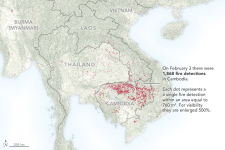
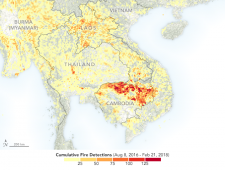
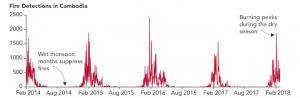
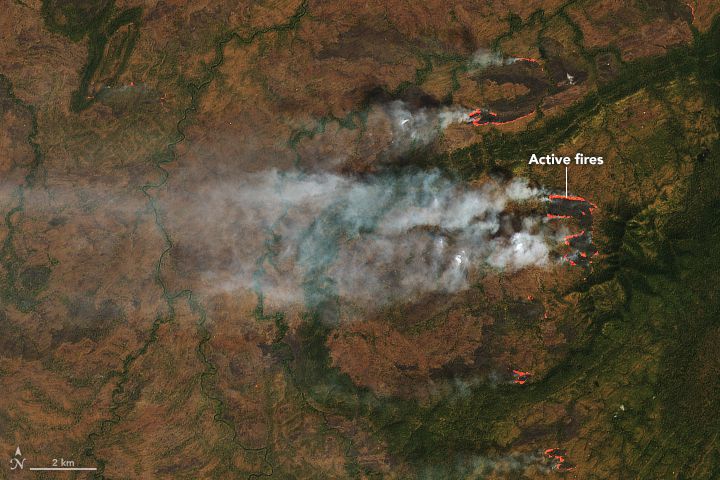
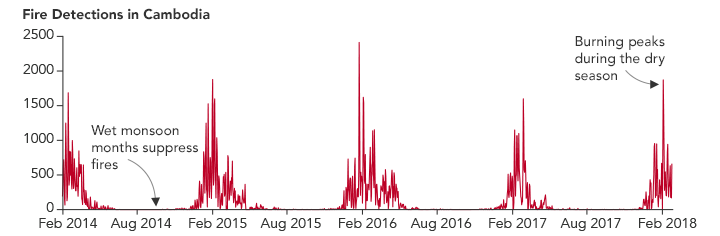
Cambodia tops region for fires detected from space

Cambodia tops region for fires detected from space

Rescued skier offers thanks

Rescued skier offers thanks

Staff Reports

A rescued skier thanked members of Douglas County Sheriff’s Search and Rescue for coming to his aid.

“The incredible and selfless work that you do, making a real difference, is something I won’t forget until the end of my days,” he said, according to the Douglas County Sheriff’s Office.

Last week two skiers were reported lost near Mott Canyon, and the search and rescue team was toned out to assist. Searchers located the two skiers around 8 p.m.

Due to weather conditions, they were not able to be evacuated and SAR remained with the two subjects overnight, where low temperatures were in the teens.

“It was a challenging event,” Sgt. Bernadette Smith said. “The rescue was a complete success with no injuries to the skiers.”

Members of Douglas County, El Dorado, and Washoe rescue personnel were involved.

Read more: https://www.recordcourier.com/news/local/rescued-skier-offers-thanks/

Myanmar delegation visits Tahoe

Myanmar delegation visits Tahoe

Staff Reports

Seven delegates visiting from the Republic of the Union of Myanmar in southeast Asia at least got to see snow at Lake Tahoe last week.

The delegates spent two days in Reno and visited Lake Tahoe to learn about the U.S. Forest Service Lake Tahoe Basin Management Unit’s role in natural resource management in the Tahoe Basin.

The delegation’s visit was made possible through the International Visitor Leadership Program and was coordinated by the University of Nevada Reno’s Northern Nevada International Center.

Tahoe Fuels Battalion Chief Kyle Jacobson and Timber Management Officer Robert Guebard facilitated a field visit for the delegation to a recent forest thinning project near Pope Beach and the Emerald Fire area.

The delegation learned about forest health and the benefits that forest thinning projects provide to the forest and surrounding communities and the importance of removing excess vegetation that can feed wildland fires.

Launched in 1940, the Leadership Program supports U.S. engagement with countries around the world in order to cultivate lasting relationships by connecting current and emerging leaders with their American counterparts.

Read more: https://www.recordcourier.com/news/local/myanmar-delegation-visits-tahoe/

To learn more, visit https://eca.state.gov/ivlp/about-ivlp and https://www.unr.edu/nnic.

Binh Thuan faces high risk of forest fires

Binh Thuan faces a high risk of forest fires

VNA

Binh Thuan (VNA) – Over 150,000 hectares of forests in the south-central coastal province of Binh Thuan are now on high alert for fires as it is in the peak of the dry season, according to the provincial Forestry Management Department on February 27.

Heat waves put forests in Tuy Phong, Bac Binh, Ham Thuan Nam, Ham Thuan Bac, Ham Tan districts, La Gi township, Phan Thiet City in a high fire alert.

The province, where the lowest rainfall is recorded in the country, has over 370 hectares of forests.

According to the agency, numerous preventive measures have been taken in each locality and by all relevant bodies during the dry season, which begins in November and ends in April every year.

Forest protection teams have been set up at all levels, involving more than 1,000 people, while 150 forest rangers have been trained on forest fire prevention.

Read more: https://en.vietnamplus.vn/binh-thuan-faces-high-risk-of-forest-fires/127116.vnp

Physics theory explains patterns of deforestation in the tropics

Physics theory explains patterns of deforestation in the tropics

Scientists get a handle on sizes of forest fragments using percolation theory

Predicting rising numbers is usually good news in ecology, but not if they are forest fragments. Current rates of deforestation could cause a 33-fold increase in forest fragments over the next 50 years, shows a study published in Nature.

Deforestation, fuelled by factors including habitat conversion and timber production, causes fragmentation. As large forests are cut into pieces, biodiversity suffers and carbon is also lost. To study patterns of tropical forest fragmentation, scientists at the Helmholtz Centre for Environmental Research (Germany) used remotely-sensed images to map more than 130 million forest fragments across 427 million hectares in the Americas, Asia, Africa and Australia.

They found that fragment sizes in three continents followed similar frequency distributions. The number of forest fragments smaller than 10,000 hectares, for instance, is similar in Central and South America (11.2 %), Africa (9.9 %) and south-east Asia (9.2 %).

“This is surprising because land use noticeably differs from continent to continent,” said mathematician and lead author Franziska Taubert in a press release. While habitat conversion is what plagues the Amazon, it is logging of commercially-important forest trees in south-east Asia.

Read more: http://www.thehindu.com/sci-tech/science/physics-theory-explains-patterns-of-deforestation-in-the-tropics/article22845393.ece

Đắk Nông keeps wary eye on forests to prevent dry season fires

Đắk Nông keeps wary eye on forests to prevent dry season fires

Update: February, 23/2018 – 09:00

Viet Nam News Đắk Nông — The Tây Nguyên (Central Highlands) province of Đắk Nông is working hard to ensure its more than 250,000ha of forests are not affected by fires during the dry season, which will last until the end of April.

More than 120,000ha face a high risk of fires. Of them, nearly 90,000ha are natural forests, according to the provincial Department of Agriculture and Rural Development.

The department’s Forest Protection Division is increasingly using information technology for forecasting forest fires and providing early warning.

Local authorities and private managers of forests have been instructed to strictly follow forest-protection and fire-prevention regulations.

Periodic fire prevention and firefighting drills are organized at localities to ensure full preparedness in case of forest fires.

Forest managers have assigned staff to monitor vulnerable areas during the dry season.

Information and instructions on fire safety are put up on boards at public places to remind the public to be vigilant.

Authorities are also strengthening other dissemination activities to raise public awareness about forest protection and fire safety. — VNS

Read more at http://vietnamnews.vn/society/423221/dak-nong-keeps-wary-eye-on-forests-to-prevent-dry-season-fires.html#FRsGqTUZFXDdvscm.99

Indonesia Mobilizes to Combat Health-Damaging Forest Fires

Indonesia Mobilizes to Combat Health-Damaging Forest Fires

Updated on

Jakarta, Indonesia (AP) — Four Indonesian provinces have declared emergencies in anticipation of worsening forest fires that each year spread health-damaging haze across much of Southeast Asia.

The National Disaster Mitigation Agency said Wednesday that emergency alerts in Riau and South Sumatra provinces on the island of Sumatra and West and Central Kalimantan on Borneo will make it easier to mobilize fire-fighting operations and support from the central government.

The agency said satellites have detected 90 “hotspots” or fires across Indonesia, with the biggest numbers in West and Central Kalimantan. Pontianak, the capital of West Kalimantan province, has been blanketed in smoke, it said.

Record Indonesian forest fires in 2015 spread haze across a swath of Southeast Asia and, according to a study by Harvard and Columbia universities, hastened 100,000 deaths.

Fires are often started by smallholders and plantation companies to clear land for planting. Many areas of Indonesia are prone to rapid burning because of the draining of swampy peatland forests for pulpwood and palm oil plantations.

Pontianak resident Reinardo Sinaga said rain in the past few days reduced the choking smoke that had affected the city for the previous two weeks.

Read more: https://www.bloomberg.com/news/articles/2018-02-21/indonesia-mobilizes-to-combat-health-damaging-forest-fires

Lack of snow brings fire concerns

Lack of snow brings fire concerns

With half the snowpack average, and nowhere near where it was this time last year, lack of snow has public lands and fire officials nervous.

Lake Tahoe snowmobilers are being asked to ride where there is actually snow.

“This winter has been a challenge for all winter recreation users,” said Tahoe Sierra Snowmobiling Club president, Greg McKay. “Snowmobilers should take extra care to minimize resource damage that low snow conditions present when they recreate and should follow Forest Service guidance.”

Snow is in the forecast for Washington’s Birthday, but accumulations are expected to be light, with even the high Sierra only forecast to see around 4 inches.

Snowmobile operators should avoid bare dirt and patchy snow and should not ride across streams or over small trees or brush, according to the U.S. Forest Service Lake Tahoe Basin Management Unit. Operating snowmobiles on too little snow create ruts in the soil and crush vegetation.