Skip to content
  • Thursday, December 11, 2025
RFMRC-SEA

RFMRC-SEA

Regional Fire Management Resource Center – South East Asia

  • Home
  • ABOUT RFMRC – SEA
    • Introduction to RFMRC-SEA
    • RFMRC – SEA ACTIVITIES
    • Partners
    • Contact
  • CURRENT FIRE AND FIRE WEATHER INFORMATION
    • Current Regional Fire Status
    • Current Global Fire Status
    • Regional Fire Weather and Smoke Pollution Early Warning
    • Other Satellite and Ground Monitoring Products
    • Current News Regional and Global
  • FIRE SCIENCE PORTAL
    • Regional
    • International
  • RESOURCES
    • Resources for Policy Makers
    • Resources for Practitioners
    • Resources for Public
    • International Wildfire Preparedness Mechanism (IWPM)
    • International Fire Aviation Guidelines
    • Research and Employment Opportunities
  • GLOBAL WILDLAND FIRE NETWORK
    • GWFN Secretariat: Global Fire Monitoring Center (GFMC)
    • Sister-Centers
    • Regional Wildland Fire Networks
    • International Peatland Fire Network
  • RFMRC – SEA ACTIVITIES
    • Webinar on Fire Prevention for Sustainable Peatland Management: Policy and Practices
  • ARCHIVE
    • RESEARCH AND PUBLICATIONS
      • Research
      • Publications
  • REGIONAL ACTORS
  • VIDEO GALLERY
  • BURN FREE MOVEMENT INDONESIA
  • PM 2.5
  • Home
  • Forestry
  • Page 2

Category: Forestry

Forest Fire Forestry RFMRC-SEA SOUTHEAST ASIA THAILAND

Bad air worsens plight

By: Panumate Tanraksa | March 29, 2020 | newspaper section: News

Toxic haze has reached a dangerous tipping point in Chiang Mai province


The bushfires that have been raging near the tourist city of Chiang Mai over the past few days are heightening concerns for both residents and the authorities with the risk they pose of extreme air pollution, coming on top of worries about the coronavirus.

(more…)

Forest Fire Forestry RFMRC-SEA SOUTHEAST ASIA THAILAND

Sun bear cub saved from forest fire

By: Saichol Srinuanchan | March 10, 2020


RATCHABURI: A sun bear cub has been saved from a forest fire in Chalerm Phrakiat Thai Prajan National Park in Ban Kha district, and is now in the care of a wildlife assistance centre.

(more…)

ASEAN Environment Forest Fire Forestry Global HAZE INDONESIA RFMRC-SEA SOUTHEAST ASIA

Sparking debate over fire use on agricultural land in Indonesia

Sparking debate over fire use on agricultural land in Indonesia

ANGGRITA CAHYANINGTYAS | Monday, 26 Nov 2018

New peatlands research center aims to reshape conservation efforts

Indonesia “I can keep my land fertile and I’m able to work regardless of the season, but my neighbor who uses the burning method has difficulties during the rains because their land becomes a swamp,” said Akhmad (Taman) Tamanuruddin, addressing delegates at the launch of a new peatland research center in Indonesia.

Taman is a farmer in Palangka Raya, the capital of Indonesia’s province of Central Kalimantan on the island of Borneo. He rejects the traditional local practice of using fire to clear residue from the fertile peatlands before planting his crops.

Instead, he applies herbicides and lets the old vegetation die off and decompose, allowing it to become a natural fertilizer.

Traditional burning practices are under scrutiny by scientists and policymakers because peatlands are effective carbon sinks. They are made up of layers of decomposed organic material built up over thousands of years. When they burn, warming gases are released into the atmosphere exacerbating climate change. Fires often burn out of control, damaging vast areas and drying out the land, rendering it useless for farming.

In 2015, the impact of wildfires was far-reaching. Fire destroyed more than 2.6 million hectares of land — an area 4.5 times the size of the Indonesian island of Bali, according to the World Bank. The price tag for the damage was more than $16 billion, the bank said.

Indonesia has since boosted efforts to ban the use of fire to clear forested peatlands to plant oil palms, maize or rice by establishing the Peatland Restoration Agency in 2016.

Legislation banning fire use to clear land was introduced in 2009 and 2014.

Research compiled in Riau province by Indonesia’s Forestry and Environment Research, Development and Innovation Agency (FOERDIA) of the Ministry of Environment and Forestry (MOEF) shows that land prepared by burning vegetation before planting is more productive. They examined peatlands cultivated for oil palm, rubber, corn, rice, and other food crops.

Oil palm yield in burned peatlands was found to be almost 30 percent greater than in those that were not, producing yields of about 13.3 tons per hectare a year. In peatlands that were not burned, yield was only 9.4 tons per hectare a year. Rubber tree yields were found to decrease on average by 46 percent if the land was not burned. Corn yield disparities were even more extreme.

Burning resulted in higher soil fertility in the peatlands. It also reduced acidity, contributing to the higher yields.

Aware of the yield benefits, many farmers involved in the study disregarded prohibitive legislation and burned off their fields. Of the study participants, only 49.3 percent stopped the practice, while 45.2 percent of respondents continued and 5.5 percent said they would give up on farming as they did not see any alternative to burning.

“Some farmers are unwilling to cultivate corn without burning since the yield will drop sharply and produce only a third or a quarter,” said Murniati, a scientist with FOERDIA.

“They were afraid to use the burning techniques but they don’t have enough money to finance the no-burning techniques,” Murniati added, explaining that farmers are scared of incurring penalties for violating anti-burning laws but feel they have no choice but to face the risk.

SEEKING ALTERNATIVES

Since he got involved in sustainable agriculture, Taman has trained hundreds of farmers.  He adds fertile soil, dolomite, and manure to his land and plants a variety of crops, including corn, chili, and vegetables.

Initially, the cost of farming in this manner may seem more expensive, but over the long term it saves him money, Taman said, explaining the environmental benefits.

Although burning more resistant vegetation is a less expensive and easier solution, it can strip nutrient levels in the soil and spoil the peatlands in the long run.

As farmers, we need more support for infrastructure to lower costs, Taman said.

“We at least need proper roads and bridges in our village to cut distribution expenses,” he added. “It can help us big time.”

Currently, poor infrastructure causes high costs for herbicides and harvested crops. Farmers are forced to rent cars to cover a short 250-meter distance because trucks cannot fit into narrow roadways.

Finding other livelihood options might be key for helping local communities thrive while conserving peatlands, according to Dede Rohadi and Herry Purnomo, scientists with the Center for International Forestry Research (CIFOR) currently working with MOEF and several partners.

The Haze Free Sustainable Livelihoods project led by CIFOR, MOEF and the University of Lancang in Riau aims to find alternatives for farmers who cultivate crops in the province.

“We try to empower communities so they can maximize the existing livelihood potentials in their village,” said Rohadi, who leads the project.

Some villages already cultivate honey, develop fisheries and grow food crops such as chili peppers and pineapples.

In addition to the Haze-free Sustainable Livelihood project, CIFOR is currently coordinating the Community-based Fire Prevention and Peatland Restoration project with Riau University, local government, communities, and the private sector.

The latest commitment from the governments of Indonesia, the Democratic Republic of the Congo and Republic of the Congo, to establish the International Tropical Peatland Center (ITPC) promise for peatland preservation efforts. ITPC is currently based at CIFOR in Bogor, near Indonesia’s capital Jakarta.

It provides valuable opportunities for cooperation in the global south to ensure policymakers, practitioners, and communities have access to trustworthy information, analyses, and the tools needed to conserve and sustainably manage tropical peatlands.

Although peatlands extend over only 3 percent of the world’s land mass, they contain as much carbon as all terrestrial biomass and twice as much as all forest biomass.

About 15 percent of known peatlands have already been destroyed or degraded.

ASEAN Environment Forest Fire Forestry HAZE INDONESIA International RFMRC-SEA SINGAPORE SOUTHEAST ASIA

‘Transboundary Haze’: The Seasonal Pollution Plaguing Southeast Asia

‘Transboundary Haze’: The Seasonal Pollution Plaguing Southeast Asia

2018/11/08, Environment | By Helena Varkkey

Transboundary haze is a form of seasonal air pollution affecting up to six Southeast Asian countries on an almost annual basis.

The first reports of this phenomenon emerged in the 1980s, and the most recent serious episode took place in 2016. The most affected countries are Indonesia, Singapore, and Malaysia. The particulate and aerosol matter that makes up the haze originates from forest and peat fires occurring during the dry season, mostly in Indonesia. When this permeates the troposphere and travels across national borders, it is known as transboundary haze.

RTX2N6PN
People take photos near the Singapore Flyer observatory wheel shrouded by haze, Aug 26, 2016.

The countries and people within reach of this smoky shroud suffer serious health, economic, and environmental consequences during each episode. The fine particles in the haze permeate deep into the lungs, which can cause serious respiratory problems, especially among young children and the elderly, sometimes resulting in death. Ophthalmological, dermatological, and psychological issues are also commonplace.

Sick days taken and school closures (during which parents often stay home to care for their children) cause significant losses in workforce productivity. These countries’ tourism industries suffer as well, as visitors have no interest in hazy skylines. Agricultural productivity and the general state of the environment also decline as the haze blocks out the sun and slows down photosynthesis.

Whither the weather solution?

With the countries affected all situated within the Southeast Asian region, the Association of Southeast Asian Nations (ASEAN) was quickly looked upon to be the driver of a workable regional solution to the haze. ASEAN began to formally identify transboundary haze as part of its remit in 1985. However, despite various ASEAN agreements, initiatives, and task forces since then, the haze persists. The haze’s effect on member countries is dire, and its causes are seemingly well understood, so ASEAN’s continued inability to effectively mitigate it is puzzling.

Scholars have laid the blame for ASEAN’s “failure” to solve the haze on weak regional governance; specifically, the limitations of its model of regional engagement through consensus, non-interference, non-confrontation, sensitivity, and politeness, as well as non-legalistic procedures – the so-called “ASEAN Way.” Describing this model as a “doctrine” to be adhered to at all costs, scholars such as Vinod Aggarwal and Jonathan Chow argue that member states’ desire to eliminate the haze has been unable to compete against the stronger desire to comply with the ASEAN Way.

However, other ASEAN observers, such as Tobias Nischalke and Shaun Narine, have argued that member states do not blindly follow the ASEAN Way. Nischalke’s research uncovered many examples where the ASEAN Way was only moderately adhered to at best. This contention was the entry point of my research: has ASEAN been failing on the haze because states are duty-bound to adhere to norms that do not encourage effective regional environmental governance? Or have the states been choosingto adhere to these norms because it is in their interests to do so? If so, what are these interests, who has been shaping them, and why are they not in line with a haze-free ASEAN?

It’s the peat, stupid!

To answer these questions, I spent six months in Indonesia, Singapore, and Malaysia conducting semi-structured interviews with over 100 individuals with experience in haze governance, including government and ASEAN officials, journalists, plantation company representatives, non-governmental organization workers, and academics.

RTS1C9G
Fires on palm oil plantations, such as this one in Jebus village on the Indonesian island of Sumatra, are responsible for a great deal of transboundary haze.

During these conversations, several points became clear.

Firstly, the type of fire matters. While regular forest fires are most common, they usually burn tree canopies. This produces little smoke and often results only in short-term, localized haze. Peat fires, on the other hand, can spread below the surface, reaching soil. Carbon-rich soil produces especially thick and sooty smoke when burnt, and this smoke can travel great distances. These fires are also harder to put out. Hence, a small amount of fires (on peatlands) are responsible for a large portion of transboundary haze.

Secondly, peat is not naturally fire-prone. In their natural state, peatlands are flooded year-round – fires only occur when peatlands are drained in preparation for planting. This dries out the peat and makes it flammable.

Thirdly, due to the importance of peatlands as carbon sinks, Indonesian law generally does not allow these areas to be developed. Despite this, and due to the decreasing availability of mineral soil, an increasing amount of peatlands have been opened for agriculture, especially for palm oil. A trend emerged, where the increasing severity of the haze matched the region’s palm oil boom in recent decades.

Hazy networks

Further interviews revealed that large plantation companies, both local and from Malaysia or Singapore, have managed to obtain licenses to access peatlands to plant crops like oil palm. Some of these companies deliberately use fire as the cheapest and quickest way to clear the land for planting. Even if these companies do not deliberately burn, the act of draining these lands makes them prone to accidental fires.

I found that strong patronage networks in this sector have enabled this to happen. Patronage is defined as a situation where an individual of higher socioeconomic position (patron) uses his influence and resources to provide protection or benefits for a person of lower status (client), who reciprocates by offering support and assistance to the patron. In this case, government patrons have provided the benefit of licenses to their clients, the business elites who own or are affiliated with these plantation companies. Furthermore, clients have also enjoyed their patrons’ protection from prosecution for haze-producing fires.

RTS37UI
A woman looks towards the Prime Minister’s office, which is shrouded in haze, in Putrajaya, Malaysia on Oct 6, 2015.

These networks are at work even at the ASEAN level. When they represent Indonesia at ASEAN, the patrons are still compelled to protect their clients. An effective ASEAN haze mitigation strategy would mean that their clients would lose access to lucrative income, and risk being prosecuted. Hence, these patrons choose to use the ASEAN Way, especially the principles of non-interference and non-legalistic procedures, to block any meaningful strategies. Malaysian and Singaporean patrons follow suit, as they also act to protect their own complicit companies. I argue that these patronage networks better explain the decisions made at the ASEAN level that have led to the failure of the bloc to solve the haze problem.

Blue skies ahead?

Since my field research, there have been some positive developments. The government of Singapore has shown a shift in its national interests, away from protecting its clients and toward the well being of its people. After several public displays of frustration with ASEAN’s lackadaisical efforts, Singapore ultimately passed its landmark Transboundary Haze Pollution Act in 2014, which empowered its courts to prosecute any party (even non-Singaporean) found to have caused haze in Singapore.

Singapore, however, has not yet been able to use this act in court, largely due to the non-cooperation of Indonesia. While ASEAN member states still meet regularly to strategize on haze matters, the strategic use of the ASEAN Way continues to limit any meaningful progress. However, as Singapore has shown, change is not impossible. I remain hopeful that other member states will eventually follow in Singapore’s footsteps to act in the common interest of the people of the region.

Helena Varkkey is a senior lecturer in the Department of International and Strategic Studies at the University of Malaya. She received her PhD in international relations from the University of Sydney in 2012 and her first book, “The Haze Problem in Southeast Asia: Palm Oil and Patronage,” was published by Routledge based on the above research in 2016.

Read Next: INDONESIA: Palm Oil Linked to Deforestation Remains on Store Shelves

This article was originally published in AsiaGlobal Online, a Hong Kong-based source of Asian perspectives on global issues. The News Lens has been authorized to republish this article.

TNL Editor: Nick Aspinwall (@Nick1Aspinwall)

Source Link: https://international.thenewslens.com/article/107781

ASEAN Economy Environment Forest Fire Forestry Global HAZE International RFMRC-SEA SOUTHEAST ASIA

Is there a market-based solution to Southeast Asia’s haze problem?

Is there a market-based solution to Southeast Asia’s haze problem?

Wednesday 7 November 2018 | By Hannah Koh

A cap-and-trade system helped to eradicate acid rain in the 1990s. Could Southeast Asia’s haze problem be beaten in the same way? American Financial Exchange chief Richard Sandor thinks so.

Trees made bare by acid rain in Smokey Mountain National Park, USA
Trees made bare by acid rain in Smokey Mountain National Park, which straddles the states of North Carolina and Tennessee in the United States. Acid rain was successfully dealt with and is no longer part of political memory, said Sandor. Image: The Shared Experience, CC BY-NC-ND 2.0

Acid rain was a major environmental problem in the 1970s and 1980s. The phenomenon was caused by the reaction of sulfur dioxide and nitrogen oxide from power factories with moisture in the atmosphere to generate acid, which fell onto earth as rain, poisoning lakes and destroying forests.

The situation began to improve in 1990 when the United States government and economists introduced a cap-and-trade system for power producers, which put in place a cap on permitted emissions and enabled companies to trade leftover allowances, said Richard Sandor, chairman and chief executive officer of the American Financial Exchange, an electronic exchange for financial institutions.

Sandor, who played a key role in orchestrating the cap-and-trade scheme to tackle acid rain, was speaking at a lecture organized by the National University of Singapore in the Southeast Asian city-state.

“The idea was to put a cap on the number of emissions nationally, and then lower the cap over a period of time,” he said. There was the outcry that electricity prices would skyrocket, America’s competitiveness would be hurt, and power-producing states such as Ohio or Illinois would go bankrupt.

Instead, a decade after the first cap-and-trade programme was implemented, emissions were down to around 4 million tonnes from a high of 18 million in the 1980s.

“Electricity prices went down. The cost to the US economy was $1.2 billion, but there was an annual reduction of $123 billion in medical expenses associated with lung diseases,” said Sandor, who is also known as the “father of carbon trading” for his work on carbon markets around the world. “That does not include 37,000 lives a year saved nor the restoration of rivers.”

But could market-based solutions solve the persistent problem of transboundary air pollution in Southeast Asia, asked moderator Tommy Koh, ambassador-at-large for Singapore’s foreign ministry.

Also known as the haze, it is caused by forests fires in Indonesia as land is cleared for palm oil plantations, said Koh.

Sandor offered two pieces of advice: to create a regional solution and to put a price on pollution.

Drawing from the example of acid rain, he said that the creation of local laws to regulate emissions from coal-fired plants resulted in utility companies building taller smokestacks so that emissions would blow into another state where the regulations didn’t apply.

“We thought of sulfur dioxide as a local problem, but it was as regional as [the haze] in Southeast Asia. It requires a regional agreement because local command and control, where there are externalities involved, just doesn’t work,” Sandor said.

When told that Asean—a political bloc of 10 Southeast Asian countries—already has an agreement to combat the haze, Sandor said pricing could be another solution.

Cap-and-trade markets work because companies find that it pays to pollute. “The question is, how do people get paid not to pollute?” he said. If polluters realize they could make money from cutting emissions—by selling leftover emission quotas, in the example of acid rain—they would do it.

Blockchain for the masses

Sandor was optimistic about the future of blockchain-based market trading, which could also empower small producers to access bigger markets. There has been a lot of hype and speculation around cryptocurrencies, which are digital tokens whose transactions are recorded on the digital open ledger that is blockchain technology, he said.

But the underlying blockchain technology is much more impactful as it can be used to facilitate trade in clean energy, as seen in South Africa’s Sun Exchange platform WePower from Lithuania, Sandor explained.

Recalling his work in Kerala state in Southern India in 2007, Sandor said he and the Chicago Climate Exchange partnered a non-governmental organization to encourage farmers to collect manure and process it using biodigesters. The methane produced was used for household cooking, and the carbon credits produced sold on the Exchange to provide additional income.

But a key obstacle was the need to travel to these remote villages to verify the carbon offsets were indeed being made, noted Sandor.

“If we had the blockchain and remote sensing … we could’ve reached 20 million rural poor [versus 150,000] because all they would’ve needed were cell phones and remote sensors and I could’ve built a blockchain registry,” he said.

Farmers who have mobile phones can record information about their crops and sustainability certification credentials on the blockchain, and take advantage of that transparency to connect with larger, international markets, said Sandor. “This is a way for an Indian farmer with a small plot of land to—because the information is recorded—be a supplier to Walmart that could never be without this technology.”

He added: “The message is: embrace change, don’t be bothered by blockchain, it’s no different to the cellphone or CNN. It’s information.”

Source Link: https://www.eco-business.com/news/is-there-a-market-based-solution-to-southeast-asias-haze-problem/

ASEAN Environment Forest Fire Forestry Global HAZE RFMRC-SEA SOUTHEAST ASIA

2018 in Environmental Review for Southeast Asia

2018 in Environmental Review for Southeast Asia

November 2, 2018, | By Gregory McCann

As 2018 comes to a close it is worth taking a look at the environmental trends throughout the year, with a special emphasis on those within the last six months or so, in order to gain an understanding of what has been happening to this region’s natural heritage and so that we might know what to look for in 2019—and how to address the upcoming challenges.

While we can say that a lot has been happening everywhere, and this is especially true for Malaysia. The country produces durian that Chinese consumers covet. This means rainforests that are currently home to tigers are being converted into plantations so that more and more of the spiky, pungent fruit can be sold to China. That means bad environmental news, with China the driver. Furthermore, clearing forests will drastically reduce the number of pollinators such as bats and other wild animals, which will, in turn, lower the durian’s quality.

Another fruit—palm oil—is almost always the whipping boy for conservation problems in Malaysia (and beyond), however, the country is making headway in its own sustainable certification program, which attempts to incorporate Environmentally Sensitive Areas (ESAs) into development blueprints across Malaysian Borneo. Nonetheless, huge development projects in Peninsular Malaysia are pushing the environment to the breaking point, with gargantuan Chinese-funded residential projects such as Forest City across the strait from Singapore serving as a striking case in point.

However, Prime Minister Mahathir Mohamad recently shut down several Chinese Belt and Road projects.  Malaysia also wants to ban importing plastic waste, as well as single-use plastic straws. Nonetheless, serious problems remain. Even without the durians-to-China issue, tiger numbers are tumbling fast, scenic Langkawi island is coming under so much stress that it may lose its Unesco status, while in Sarawak the forest-dwelling Penan indigenous group continue to block bulldozers and fight for their traditional lands. However, a rehabilitated Bornean orangutan was successfully rewilded in Sabah’s Tabin Wildlife Sanctuary, the first orangutan to fully return to the forest after such a long spell in captivity and rehabilitation, and a clouded leopard was sighted within the vicinity of a local hospital.

Across the Strait, in Indonesia, ecological issues are festering as well. While a new species of songbird has been identified on Rote Island, five other bird species have lost their protected status. The endemic Sumatran laughing thrush is fast disappearing, while the Helmeted Hornbill is relentlessly persecuted in Indonesia. The caged bird trade is bringing many species to the brink of extinction in the archipelago, and biologists say many forests where they work are becoming increasingly “quiet.”

Forest fires raged in South Sumatra and Riau provinces in 2018, and Chinese developers are stubbornly pushing ahead with a hydroelectric dam in the Batang Toru forest, home to the rarest species of the orangutan in the world. The Critically Endangered Sumatra rhinoceros is still in big trouble but there is a movement on to save it, while a pregnant Sumatran tigress was caught and died in a pig trap in Riau.

Like Malaysia, Indonesia has a major palm oil problem, but the country’s anti-graft department says it’s ready to take action against transgressors who are felling natural forest and breaking other laws. Sadly, the Bali government wants to build an elevated highway right on top of some of its last undeveloped sandy beaches. The small volcanic island of Krakatoa in the Sunda Strait between Java and Sumatra has spewed lava and ash this year.   Widespread deforestation, poaching, overfishing, and plastic pollution has been taking over this island nation. Indonesian Presidential contender Prabowo has said that if he is elected to office he will review China’s Belt and Road plans, which could include a cancellation of the Batang Toru dam, and a court in Aceh recently threw down its stiffest penalty to date for two men caught trying to sell a tiger pelt.

Asia Sentinel recently reported on the surprising amount of wildlife to be found in Singapore today. Thailand also received high environmental marks in a recent Asia Sentinel critique, however, Thai-language media recently uncovered a story about a Vietnamese national caught with tiger bones in the kingdom— particularly worrying report as Vietnamese poachers are among the most tenacious in Asia.

Making matters worse, a new and improved road through Kaeng Krachan National Park will likely lead to greater disturbance to the forest’s wildlife, while a few provinces to the north a Burmese national gunned down a binturong. There is rising sentiment to build a Kra Isthmus Canal in Thailand. A large crocodile was caught off the Krabi coast, a whale shark was recently spotted of Koh Racha, and local conservationists have thus far succeeded in fending off a new marina development project in Phuket. However, the deluge of Chinese tourists into the kingdom is pushing Thailand to its breaking point, and it was largely Chinese tourists who are responsible for the closing of Maya Bay in Koh Phi Phi, which remains closed indefinitely so that it can recover.

In Laos, the Nam Theun 2 Dam has been such a disaster that its main financier, the World Bank, has thrown in the towel and walked away.  In Dead in the Water: Global Lessons from the World Bank’s Hydropower Project in Laos contributing author Glenn Hunt remarks: “For one of the pillars that were supposed to be the primary source of income, it’s been an unmitigated disaster.” With about 140 dams either under construction or on the drawing board in its quest to be the “battery of Asia,” Laos faces the potential for most disasters and large-scale environmental and social degradation in a country that has already lost its wild tigers, leopards, and many other species.

Despite the tragedy that unfolded in Attapeu province when a large dam collapsed, Laos remains bullish about constructing more dams. And the dam-building frenzy is harming the environment and wildlife all around the country. And while a recent Guardian write-up describing the fantastic-look am Et-Phou Luey ecotourism program up in the north of the country describes a healthy tiger population in this region, perhaps the author was given old data.

Wild elephants are reportedly being skinned alive in Myanmar to satisfy a new Chinese demand—for “blood beads,” which are blood-filled chunks of elephant fat. The previous link provides a window into some twisted tastes: “The online trader wants his customers to know the elephant was skinned quickly, with blood still fresh in its veins.” Chinese demand for elephant skin used in bags in jewelry was already shocking, but things can always get worse when it comes to wildlife.

But in more uplifting news from the country, Irrawaddy dolphins are being given greater protections, and the government is also cracking down on illegal wildlife trade in the city of Yangon.

Taking note of how poorly elephants working in tourism are treated across Asia, Vietnam has launched the region’s first “ethical elephant experience.” The country has also taken an interest in seeing that its shrimp farming industry become more sustainable, while the government also recently signed a deal with the EU that promises a reduction in illegal logging (though some in neighboring Cambodia have serious doubts about this). We reported earlier this year that Vietnam’s wildlife is in rough shape, and things haven’t taken much of a turn for the better since.

And finally, Cambodia.  A recent camera-trap check-in Virachey National Park so delighted the Ministry of Environment that he shared some of the photos on their Facebook page; even the Thai media took notice of the results. Asia Sentinel reported earlier this year that Cambodia is probably the last hope for Indochina’s wildlife, and this still holds true, despite the fact that nearly 110,000 snares were found in a single national park. A man was recently killed by a wild boar near the Cardamom Mountains, while Kratie province is cracking down on illegal mining, and at the same time, the central government is demanding that villagers who grabbed national park land return it.

In other news from the region, the Maubere tribe of Timor-Leste is bringing back ancient customary laws to help protect its forests, seas, and coastline. Chinese demand for logs is wiping out the forests of the Solomon Islands. India is losing tigers and elephants, while two elephants were struck by a train and killed in Sri Lanka.

As always, China casts a menacing shadow over Southeast Asia and nowhere is this more clear than on the Mekong River and in the South China Sea. The region, with the help of the US and Japan, must find a way to manage Chinese aggression in the South China Sea and beyond, and then some of the numerous dams that it has planned for the region have to be canceled or scaled down.

Beyond that, Chinese citizens have to be educated about wildlife product consumption, including shark fins, tiger parts, bear gallbladder, elephant skin and blood, and much more, which have no known scientific value. And in a shocking and disturbing announcement,  China has said that it will lift its decades-old ban on the trading of tiger parts and rhino horn, a move that will almost certainly put these species in greater danger.  Or else one of the most biologically rich regions of the world loses everything that made it so special.

Gregory McCann is the Project Coordinator of Habitat ID, and the author of Called Away by a Mountain Spirit: Journeys to the Green Corridor. You can support his conservation projects in Cambodia and Sumatra here.

Source Link: https://www.asiasentinel.com/society/2018-environmental-review-southeast-asia/

ASEAN CAMBODIA Environment Forest Fire Forestry Global HAZE RFMRC-SEA SOUTHEAST ASIA

Cambodian PM Vows to Shoot Loggers From Helicopters, Again

Cambodian PM Vows to Shoot Loggers From Helicopters, Again

Published: Tuesday, 02 October 2018 16:33

Cambodian Prime Minister Hun Sen promised on Sunday that he would fix his country’s problems with rampant deforestation by shooting those who illegally chop down timber from helicopters.

mondulkiri deforestation
Deforestation in Mondolkiri, Cambodia (CC 4.0)

“It’s correct that we are losing our forests, many are being replaced by rubber plantations,” he said, speaking to members of the Cambodian diaspora in New York.

“I acknowledge that thieves have illegally cut down timber and I am ordering them to be shot from helicopters in the sky.”

Hun Sen made a similar promise two and a half years earlier when he announced that General Sao Sokha, newly appointed as head of a task force to stop illegal logging and timber smuggling, was authorized to fire rockets at loggers from helicopters.

That order came a year after a Global Witness report showed that Hun Sen’s own personal advisor, Try Pheap, headed an illegal logging network that saw millions of dollars of rosewood smuggled to China each year.

Not a shot has been fired from helicopters since that order and the task force did not succeed in halting the flow of luxury timber across Cambodia’s borders to Vietnam.

Hun Sen’s relatives have also long been linked with the country’s illegal timber business.

With hectares of forest falling to loggers and economic land concessions dished out by Cambodia’s ruling party, the country has one of the world’s highest rates of deforestation.

Global Witness meanwhile estimates that evictions that have resulted from logging and the government giving land to agribusinesses have displaced 830,000 people, forcing some into squatting in state forests or cutting down timber themselves.

Speaking Sunday, however, Hun Sen emphasized that it was the country’s now-defunct opposition–whose leader is in exile and whose deputy leader is just out of prison–that should be blamed for illegal logging.

“In many cases [the thieves] went to cut down millions of hectares to cultivate farmlands, including groups [affiliated] with the former opposition,” he said.

Source Link: https://www.occrp.org/en/daily/8677-cambodian-pm-vows-to-shoot-loggers-from-helicopters-again

ASEAN Environment Forest Fire Forestry Global INDONESIA RFMRC-SEA Wildfire

Forest fire breaks out on slopes of Bali’s Mount Agung

The forest fire breaks out on slopes of Bali’s Mount Agung

Coconuts Bali | 4 days ago

a view of a river: mount agung forest fire bali post sept 28 2018

Mount Agung forest fire Bali post sept 28, 2018

The Suwung landfill in South Denpasar is not the only place burning in Bali at the moment.

A forest fire broke out on the slopes of Bali’s Mount Agung on Thursday.

Wooded areas around Daya and Kubu have been observed smoking, however, this fire’s not an easy one to put out.

The burn area lies inside steep terrain of the eruption hazard zone of Mount Agung, which persists at level III “standby” status for an eruption.

There continues to be an exclusion zone recommended by Indonesia’s volcanology center, encompassing a four-kilometer radius from the volcano crater, which has been extended and reduced back down to four kilometers a number of times since the Bali volcano rumbled back to life last year. Outside of this exclusion zone, Bali remains safe and tourists are urged by the government to still come for holiday.

Head of the Karangasem Fire Department I Nyoman Sutirtayasa said that his department has been coordinating with officers from East Bali Forest Protection Management (RPH) to put out the fire at an altitude of about 1,500 meters above sea level.

“Officers from East Bali RPH are conducting fire monitoring at monitoring posts,” Sutirtayasa told Bali Post on Thursday.

The officers are ready to start fighting the fire if it spreads further down outside of the exclusion zone, but at the moment the terrain is to challenging to access the burn location, according to the fire department head.

“The route to the (fire) location is difficult. The effort that can be done now is to prevent the spread of the fire to the lower slopes. If we go up, we do not dare enter the danger zone,” Sutirtayasa told Tribun Bali.

“The area of land burning is getting wider. The fire has reached the south of Mount Agung and has spread to forested land above Pajenengan Temple, Pempatan Village. The cause of the fire is still unknown,” Sutirtayasa said.

Meanwhile, Made Warta, head of the East Bali Forest Management Unit says that his officers have been working with local residents to try and contain the downward spread of the fire. They also dare not risk entering the danger zone, but they have been extinguishing flames trying to come down the mountain.

There are three apparent hotspots that have appeared and the burn area is estimated to be about a hectare, Warta told Tribun.

There isn’t even a hiking trail to one of the areas, Warta explained of the difficult access.

Hot weather and strong winds have been contributing factors in allowing the fire to spread and flare up.

The post Forest fire breaks out on slopes of Bali’s Mount Agung appeared first on Coconuts.

Source Link: https://www.msn.com/en-sg/news/world/forest-fire-breaks-out-on-slopes-of-bali-e2-80-99s-mount-agung/ar-BBNEAcX

Environment Forest Fire Forestry Global Repository Resources RFMRC-SEA Wildfire

The Sordid History of Forest Service Fire Data

The Sordid History of Forest Service Fire Data

by Randal OToole 09/27/2018

800px-Carr_Fire_28_July_2018_b.jpg

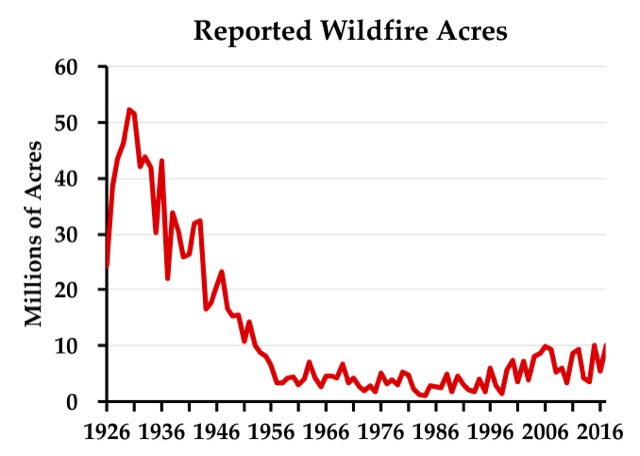
The latest wildfire situation report indicates that about 7.3 million acres have burned to date this year. That’s about 1.2 million acres less than this same date last year, but about 1.5 million acres more than the ten-year average and a lot more than the average in the 1950s and 1960s, which was about 3.9 million acres a year.Some people use the data behind this chart to argue against anthropogenic climate change. The problem is that the data before about 1955 are a lie. Click image to go to the source data.

While some blame the increase in acres burned on human-caused climate change, skeptics of anthropogenic warming have pointed out that, according to the official records, far more acres burned in the 1930s — close to 40 million acres a year — than in any recent decade. The 1930s were indeed a decade of unusually bad droughts that can’t be blamed on anthropogenic climate change.

While the Antiplanner isn’t persuaded that recent fires are evidence of human-caused global warming, reports of acres burned from before about 1955 are not evidence of the opposite for a simple reason: the Forest Service lied. While the Antiplanner has alluded to this before, it’s important to tell the full story so that skeptics of climate change don’t reduce their credibility by using erroneous data.

The story begins in 1908, when Congress passed the Forest Fires Emergency Funds Act, authorizing the Forest Service to use whatever funds were available from any part of its budget to put out wildfires, with the promise that Congress would reimburse those funds. As far as I know, this is the only time any democratically elected government has given a blank check to any government agency; even in wartime, the Defense Department has to live within a budget set by Congress.

This law was tested just two years later with the Big Burn of 1910, which killed 87 people as it burned 3 million acres in the northern Rocky Mountains. Congress reimbursed the funds the Forest Service spent trying (with little success) to put out the fires, but — more important — a whole generation of Forest Service leaders learned from this fire that all forest fires were bad.

In 1924, Congress passed the Clarke-McNary Act, which allowed the Forest Service with (i.e., provide funds to) “appropriate officials of the various states or other suitable agencies” in developing “systems of forest fire prevention and suppression.” The Forest Service used its financial muscle to encourage states to form fire protection districts.

This led to a conflict over the science of fire that is well documented in a 1962 book titled Fire and Water: Scientific Heresy in the Forest Service. Owners of southern pine forests believed that they needed to burn the underbrush in their forests every few years or the brush would build up, creating the fuels for uncontrollable wildfires. But the mulish Forest Service insisted that all fires were bad, so it refused to fund fire protection districts in any state that allowed prescribed burning.

The Forest Service’s stubborn attitude may have come about because most national forests were in the West, where fuel build-up was slower and in many forests didn’t lead to serious wildfire problems. But it was also a public relations problem: after convincing Congress that fire was so threatening that it deserved a blank check, the Forest Service didn’t want to dilute the message by setting fires itself.

When a state refused to ban prescribed fire, the Forest Service responded by counting all fires in that state, prescribed or wild, as wildfires. Many southern landowners believed they needed to burn their forests every four or five years, so perhaps 20 percent of forests would be burned each year, compared with less than 1 percent of forests burned through actual wildfires. Thus, counting the prescribed fires greatly inflated the total number of acres burned.

The Forest Service reluctantly and with little publicity began to reverse its anti-prescribed-fire policy in the late 1930s. After the war, the agency publicly agreed to provide fire funding to states that allowed prescribed burning. As southern states joined the cooperative program one by one, the Forest Service stopped counting prescribed burns in those states as wildfires. This explains the steady decline in acres burned from about 1946 to 1956.

There were some big fires in the West in the 1930s that were not prescribed fires. I’m pretty sure that if someone made a chart like the one shown above for just the eleven contiguous western states, it would still show a lot more acres burned in real wildfires in the 1930s than any decade since — though not by as big a margin as when southern prescribed fires are counted. The above chart should not be used to show that fires were worse in the 1930s than today, however, because it is based on a lie derived from the Forest Service’s long refusal to accept the science behind prescribed burning.

This piece first appeared on The Antiplanner.

Randal O’Toole (rot@ti.org) is a senior fellow with the Cato Institute and author of the new book, Romance of the Rails: Why the Passenger Trains We Love Are Not the Transportation We Need, which will be released by the Cato Institute on October 10.

Source Link: http://www.newgeography.com/content/006096-the-sordid-history-forest-service-fire-data

ASEAN Environment Forest Fire Forestry HAZE Hotspots INDONESIA RFMRC-SEA SOUTHEAST ASIA Wildfire

BMKG Detects 12 Hotspots in Riau, Indication of Forest Fire

BMKG Detects 12 Hotspots in Riau, Indication of Forest Fire

Tuesday, 25 September 2018 | 13:06 WIB

TEMPO.CO, Pekanbaru – Meteorology, Climatology and Geophysics Agency (BMKG) detected 12 hotspots in Riau Province, which became an early indication of forest and land fire, on Tuesday morning.

Based on the data from BMKG Pekanbaru Station that was updated at 7:00 am, Riau still dominates the number of hotspots on Sumatra Island since the beginning of this week. In total, there are 23 hotspots in Sumatra, and 12 of them are in Riau.

There are five hotspots in South Sumatra, three in Lampung, two in Bangka Belitung, and one in Bengkulu.

Head of BMKG Pekanbaru Station, Sukisno stated the number of hotspots increased compared to on Monday afternoon, September 24, which was 11 hotspots. Of the 12 hotspots, the most were in Pelalawan District, five hotspots.

In Siak and Meranti Islands, there were three hotspots and Indragiri Hulu has one hotspot. In addition, there were two hotspots that have a level of confidence above 70 percent. “These two hotspots are in Pelalawan and Meranti Islands,” he said.

ANTARA

Source Link: http://en.tempo.co/read/news/2018/09/25/206921950/BMKG-Detects-12-Hotspots-in-Riau-Indication-of-Forest-Fire

Posts pagination

Previous 1 2 3 … 10 Next

RFMRC-SEA

Fire Simulator Training

https://rfmrc-sea.org/wp-content/uploads/2025/04/TRAINING-FIRE-SIMULATOR.mp4

Global Landscape Fire Awards 2019

https://rfmrc-sea.org/wp-content/uploads/2019/09/Global-Landscape-Fire-Award-2019.mp4

Meet Bambang Hero Saharjo, Indonesia’s go-to expert witness against haze-causing plantation firms (Mongabay)

https://rfmrc-sea.org/wp-content/uploads/2019/04/Meet-Bambang-Hero-Saharjo-Indonesias-go-to-expert-witness-against-haze-causing-plantation-firms.mp4

Multistrata Fieldwork (IPB and NASA) Riau, 18 Apr 2019

https://rfmrc-sea.org/wp-content/uploads/2019/06/WhatsApp-Video-2019-06-27-at-13.29.42.mp4

Calendar

December 2025
M T W T F S S
 1
2345678
9101112131415
16171819202122
23242526272829
30  
« Jun    

Contact

IPB University Dramaga Campus Ulin Street, Forest Biology Build 2.1.4 Faculty of Forestry, Bogor 16680, West Java, Indonesia
Telp: (0251) 8421929
Wattsap : +62 812 9000 2231
Email: rfmrc@apps.ipb.ac.id

Login

Copyright © 2025 RFMRC-SEA
Theme by: Theme Horse
Proudly Powered by: WordPress