Forest fires: Satellites detect 62 hotspots in North Sumatra

Forest fires: Satellites detect 62 hotspots in North Sumatra

Reporter: Juraidi, Fardah | Editor: Rahmad Nasution
29th March 2022

Medan, North Sumatra (ANTARA) – The Meteorology, Climatology, and Geophysics Agency (BMKG) has reported 62 hotspots indicating forest or plantation fires in a number of areas in North Sumatra province on Tuesday.

(more…)

Thailand detects over 15,000 hotspots in forests and farmlands

Thailand detects over 15,000 hotspots in forests and farmlands

The most hotspots in the North amounted to 2,823 in Mae Hong Son province, followed by 1,971 hotspots in Lampang and 1,665 in Chiang Mai.

The Interior Ministry has detected 15,716 hotspots which cause haze so far this year.

Sutthipong Chulcharoen, permanent secretary of the Interior Ministry, said that from Jan 1 to March 20 there were 15,716 hotspots including 6,757 in national forest reserves, 4,594 in conservation forests and 2,172 in farmland.

The most hotspots in the North amounted to 2,823 in Mae Hong Son province, followed by 1,971 hotspots in Lampang and 1,665 in Chiang Mai.

In the corresponding period last year there were 51,536 hotspots. This year’s hotspots dropped by 35,820 or 69.50%.

Mr Sutthipong said the Interior Ministry instructed governors of all provinces, especially those in 17 Northern provinces, to monitor local forest fires, hotspots and haze situations, improve response plans and order organizations concerned to take legal action strictly to limit haze. (TNA)

Link: https://www.pattayamail.com/thailandnews/thailand-detects-over-15000-hotspots-in-forests-and-farmlands-393103

Sustainable forests for combating climate change

Sustainable forests for combating climate change

Reporter: Prisca T V, Mecca Yumna | Editor: Sri Haryati
21 March 2022

Jakarta (ANTARA) – Indonesia is ready to embark on a new chapter of life, as the Nusantara Capital City begins its development with the rehabilitation of forests in the area, as said by President Joko Widodo.

During a visit to the Mentawir Nursery, North Penajam Paser District, East Kalimantan, on March 14, 2022, the president said that the rehabilitation was meant to revitalize the forest area around the city to its original function as a tropical forest and not a homogeneous monoculture expanse of vegetation.

Efforts to rehabilitate forests in the new capital will be supported by construction of the Mentawir Nursery that will produce 15-20 million seedlings to be planted in critical lands.

The measure was taken to materialize the concept of a forest city for the new capital, wherein of the 256 thousand hectares of the IKN authority area, around 70 percent is in the form of natural cover and trees.

Not only the new capital city, but other forests in Indonesia were also rehabilitated by the government, through the Environment and Forestry Ministry, in a bid to suppress the rate of deforestation in the country.

Rehabilitation efforts have been one of Indonesia’s focuses in recent years. The focus also extended to peat and mangrove areas.

Establishment of the Peatland Restoration Agency, which is now the Peat and Mangrove Restoration Agency, indicated the government’s commitment to restoring and rehabilitating degraded peat and mangrove areas.

The forestry and other land use (FOLU) sector is also in the spotlight when Indonesia targets a net carbon sink in the sector by 2030. It was expected that net zero emissions could be achieved in 2060 or earlier.

In the updated Nationally Determined Contribution (NDC) climate target document, Indonesia targets a 29-percent reduction in greenhouse gas emissions by 2030 alone. If the global community extended its support, it is expected to reach the 41-percent target of reduction.

Of these targets, FOLU has the largest reduction target of 17.2 percent through individual efforts and 24.1 percent with support from the global community.

The rest came from the energy sector (11 percent and 15.5 percent), waste (0.38 percent and 1.4 percent), agriculture (0.32 percent and 0.13 percent), and industry and product use or IPPU (0. 10 percent and 0.11 percent).

Indonesia’s commitment in the FOLU sector resulted in several achievements, one of which was the reduction of deforestation by 75 percent to 115,460 hectares during the 2019-2020 period.

This figure shows a decrease as compared to the deforestation of 462,460 hectares during the 2018-2019 period.

According to the ministry’s data, the gross deforestation rate during the 2019-2020 period reaches around 119,091 hectares, with reforestation covering an area of 3,631 hectares. Meanwhile, gross deforestation during the 2018-2018 period was recorded at 465,500 hectares and the reforestation area reached three thousand hectares.

The area burned due to forest fires has decreased in recent years. Based on SiPongi data from the Environment and Forestry Ministry, the area burned in 2021 reached 358,867 hectares, or up from 296,942 hectares in 2020.

However, this number shows a drastic decrease from the area burned in 2015 and 2019, which reached 2.6 million hectares and 1.6 million hectares, respectively.

In 2021, vegetative forest and land rehabilitation efforts were also conducted in an area of 203,386 hectares.

It comprises forest rehabilitation in an area of 46,752 hectares and mangrove rehabilitation in an area of 35,881 hectares.

As efforts to rehabilitate the land were made in an area of 67,138.73 hectares, so were the efforts to rehabilitate watersheds spanning an area of 11,709 hectares.

Sustainable forest

Environment and Forestry Minister Siti Nurbaya Bakar stated that Indonesia will continue to move to fulfill its commitments to control climate change without waiting for promises from developed countries. She delivered the statement on the occasion of the 2022 Forester Service Day.

To cement Indonesia’s commitment to achieving the FOLU Net Sink target by 2030, the ministry issued the Decree of the Environment and Forestry Ministry Number 168 of 2022 that contains the 2030 FOLU Net Sink Operational Plan.

The minister stated that after 2030, the FOLU sector was expected to be able to absorb greenhouse gases along with reducing emissions from energy transition activities as well as other sector exploration activities to achieve carbon neutral or net zero emissions by 2060.

Minister Bakar said that the program would apply the principles of sustainable development that include sustainable forest management as well as environmental governance and carbon management.

The main target remains on the efforts to reduce deforestation and forest degradation, she highlighted.

Although it is not easy, Indonesia will continue to employ the principles of sustainability as the basis for environmental development.

This sustainable foundation is also the theme of World Forest Day 2022, which is commemorated every March 21. This year’s theme is “Forests and Sustainable Production and Consumption.”

As quoted from the Food and Agriculture Organization (FAO) website of the United Nations, sustainable forest management is one of the keys to dealing with climate change.

Forests also play an important role in addressing poverty issues and meeting the targets of the Sustainable Development Goals.

Professor Herry Purnomo of the Faculty of Forestry at Bogor Agricultural University opined that public contribution was necessary to encourage sustainable forest management.

One effort that the public can make to contribute to the cause is to use certified forestry products.

The professor deemed it important since by buying certified products, the entrepreneur or forest manager would strive to meet such demands, thereby following the regulations of sustainable forest management.

Some of the certificates for sustainable forest production are the Timber Legality Verification System, or SVLK, issued by the government. SVLK aims to ensure that wood products and their raw materials are obtained from legal sources.

There are also several other certifications, such as global-scope ecolabels issued by the Forest Stewardship Council.

Some products with certifications that can be used by the community were furniture and paper, he pointed out.

To encourage the public to use forest products from sustainable sources, it is necessary to promote the behavior on a national or regional scale. People could start by using certified forestry products in government buildings.

He also called for consistency in the environmental recovery efforts that had been successfully brought up by Indonesia, using the momentum, such as the Indonesian G20 Presidency.

He expected that annually, efforts would be made consistently to decrease deforestation and increase reforestation.

Indonesia currently leads in terms of reducing deforestation, and the global community is mostly focused on various efforts being undertaken in the country.

By consistently pushing for a sustainable system and encouraging environmental recovery, Indonesia can lead by setting an example, backed up by the leadership of the G20 2022, he concluded.

COPYRIGHT © ANTARA 2022

Link: https://en.antaranews.com/news/220985/sustainable-forests-for-combating-climate-change
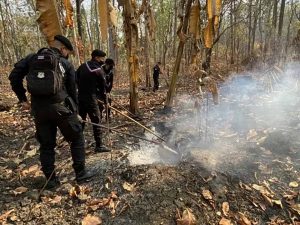
Illegal burning in Northern Thailand contributes harmful levels of air pollutant PM2.5

Illegal burning in Northern Thailand contributes harmful levels of air pollutant PM2.5

Published on

Illegal burning in more than 135 areas in the northern province Mae Hong Son has contributed to the rise of the air pollutant PM2.5 to levels considered to be harmful to human health. Authorities are also concerned that the poor air quality could also worsen the condition of Covid-19 patients in the area. Today, the air quality in Mae Hong Son reached what IQ Air considers “Very Unhealthy” levels.

Some fires in the north of Thailand are from crop burning where farmers intentionally set fire to fields after harvesting to quickly clear the land and fertilise the soil. The debate on the illegality of crop burning has been a longstanding issue between farmers and the Thai government.

Thai media reports that some officials suspect that some of the fires were caused by illegal gangs smuggling teak wood and burning the stumps to destroy the evidence. The Mueang district chief officer, Pongpeera Choochuen, says those who start the fires in the forest will be arrested and face criminal charges.

A satellite also detected 1,000 hot spots in the province’s preserved forests which are at risk of wildfire. Pongpeera is urging residents in the Mueang district to help monitor the forest. By communities, he says residents should set firebreaks, which are typically strips of bare soil to prevent a fire from spreading. He also asked residents to keep a lookout at who is going in and out of the forest.

SOURCE: Khaosod | Siamrath

Link: https://thethaiger.com/hot-news/environment/illegal-burning-in-northern-thailand-contributes-harmful-levels-of-air-pollutant-pm2-5

Deforestation in Southeast Asia

Deforestation in Southeast Asia

BY OLIVIA LAIASIA | 7 MAR 2022

Forests cover just over 30% of the global land area, yet they harbour a vast majority of the world’s wildlife species – including 80% of the world’s amphibians, 75% of birds, and 68% of mammals. But since 1990, over 420 million hectares of forest have been lost as a result of human activity, largely due to deforestation and land clearing for agricultural purposes and logging. Southeast Asia has one of the highest rates of deforestation in the world to support the region’s agricultural and food production, as well as other raw material industries. We discuss what was the major cause of deforestation in Southeast Asia and look ahead to the future. 

Southeast Asia, including Indonesia, Malaysia, Vietnam, and Thailand, is home to nearly 15% of the world’s tropical forests, which makes it all the more attractive as a deforestation hotspot. The region has one of the highest rates of deforestation, losing at least 1.2% of its forests annually, which is comparable only to Latin America where deforestation rates in the Amazon account for one-third of global tropical deforestation.

(more…)

Fire fighters containing forest fires in Ob Khan national park in Chiang Mai

Fire fighters containing forest fires in Ob Khan national park in Chiang Mai

March 5, 2022

Chiang Mai Provincial Governor Prachon Prachsakul has ordered local officials and relevant agencies to assist in containing the spread of forest fires at Ob Khan national park in the province.

About 35 fire fighters from the national park and the Mirror Foundation, who have been battling the fires, have complained that there are not enough of them to cope with the fires, which have been burning for more than three days and stretch for about three kilometres through the forest in the park.

Without timely reinforcements, they have expressed concern that the entire 6,000 hectare forest may be wiped out.

The line of fires is located far from communities, but satellite images have detected many hot spots, many of them close together.

Nipaporn Paisarn, the national park chief, said that damage to the forest cannot be assessed yet.

According to the governor, the fires are concentrated in four locations in the park and men from Hang Dong district office have already been sent to battle the fires.

Meanwhile in the neighbouring province of Mae Hong Son, the level of PM2.5 dust in the atmosphere is beyond safety limits due to fires in the province and in Myanmar.

2,000 hot spots have been detected in Myanmar and 800 in Mae Hong Son from satellite images.

Most fires in Thailand’s northern provinces were man-made, when farmers burn farm waste or when villagers set fires in forests to help them hunt for wildlife.

Link: https://www.thaipbsworld.com/fire-fighters-containing-forest-fires-in-ob-khan-national-park-in-chiang-mai/

16 Hotspots of Possible Forest Fires Detected in East Kalimantan

16 Hotspots of Possible Forest Fires Detected in East Kalimantan

Translator: Antara | Editor: Petir Garda Bhwana
28 February 2022 10:47 WIB

TEMPO.COJakarta – The Meteorology, Climatology and Geophysics Agency (BMKG) detected 16 hotspots indicating forest fires in five districts in East Kalimantan Province.

“A total of 16 hotspots are detected today starting at 1 a.m. until 4 p.m. WITA (Central Indonesian Standard Time) and we have immediately conveyed (the information) to the respective districts,” Iwan Munandar, forecaster at the Sultan Aji Muhammad Sulaiman (SAMS) Sepinggan Meteorology Station, said on Saturday.

(more…)

Thailand: Foreign tourists moved to safety as forest fire breaks out in Phuket’s Rawai area

Thailand: Foreign tourists moved to safety as forest fire breaks out in Phuket’s Rawai area

Sunday, 06 Feb 2022

BANGKOK, Feb 6 (The Nation Thailand/ANN): Tourists were evacuated when a forest fire broke out on Laem Krating Cape in Phuket’s Rawai subdistrict on Saturday night (Feb 5).

(more…)

Smog from Cambodia brings haze to parts of Malaysia

Smog from Cambodia brings haze to parts of Malaysia

Published by: ARNOLD LOH | NATION | Friday, 28 Jan 2022

GEORGE TOWN: Smog from tens of hotspots burning in Cambodia – about 1,000km away – is blowing toward Malaysia, bringing haze to northern states.

The Asean Specialised Meteorological Centre (ASMC), based in Singapore, reported that satellite cameras have detected massive fire-prone areas emitting smoke plumes in northern and eastern Cambodia as well as parts of southern Laos.

The northeast monsoon has been blowing the smoke towards Malaysia and ASMC forecasts a slight to moderate haze.

The Air Pollutant Index (API) of Malaysia website operated by the Environment Department shows that for most parts of Kelantan, Terengganu, southern Kedah and Penang have moderate API readings in the 60s to 70s.

In South Seberang Prai, Penang, the API is 92, but this is due to Penang’s landfill fire in Pulau Burung.

The Malaysian Meteorological Department also sent out a haze alert on Thursday (Jan 28), characterising the hotspots in Cambodia as forest fires.

On Jan 11, Phnom Penh Post in Cambodia reported that the nation’s forest fires are “frequently caused by human activities, such as burning brush that has been cleared on plantations, burning tree stumps in fields to make it easier to grow crops, creating grasslands for livestock or in poaching attempts as well as to harvest honey from wild bees”.

In Shah Alam and Klang in Selangor, the API reading is in the 70s to 80s.

An API reading of 0-50 is considered Good, Moderate (51-100), Unhealthy (101-200), Very Unhealthy (201-300) and Hazardous (above 300).

Link: https://www.thestar.com.my/news/nation/2022/01/28/smog-from-cambodia-brings-haze-to-parts-of-malaysia

Indonesia’s new epicenter of forest fires shifts away from Sumatra and Borneo

Indonesia’s new epicenter of forest fires shifts away from Sumatra and Borneo

by  on 29 December 2021

JAKARTA — Indonesia’s land and forest fires burned a greater area this year than in 2020, with most of the fires occurring in West Nusa Tenggara and East Nusa Tenggara, two provinces that were until recently not major sites of burning.

As of the end of November, fires had burned 353,222 hectares (872,831 acres) of land, an area twice the size of London. This is up nearly 16% from the 296,942 hectares (733,759 acres) burned during the whole of 2020, according to official data from the Ministry of Environment and Forestry.

The largest increase in fires occurred in the provinces of West Nusa Tenggara (NTB) and East Nusa Tenggara (NTT), which until a few years ago accounted for only a fraction of total fires.

This year, fires in NTB burned 100,908 hectares (249,349 acres), nearly a third of the national total, and more than triple the area burned in the province last year. In NTT, the figure was higher, at 137,297 hectares (339,268 acres) were burned, up nearly 20% from the 2020 figure.

This makes NTB and NTT the top two provinces in terms of size of fires for two years in a row. Together, fires in the two provinces accounted for two-thirds of the total burned area in Indonesia this year; in 2020, the two provinces were home to half of the total burned area.

In 2019, which saw a particularly bad episode of fires fanned by an El Niño system bringing drier-than-usual weather conditions, the worst-hit regions were the Bornean provinces of Central Kalimantan, with 134,227 hectares (331,682 acres) burned, and West Kalimantan, at 127,462 hectares (314,965 acres).

Among the areas burned by the fires this year was part of an island within NTT’s Komodo National Park, a UNESCO World Heritage Site and home to around 2,800 Komodo dragons (Varanus komodoensis).

Raffles B. Panjaitan, a fire expert working as an adviser to the minister of environment and forestry, said the scale of the burning in NTT and NTB was unprecedented.

“In the past two years, the fires in NTT and NTB increased to more than 100,000 hectares each,” he said at an event in Jakarta on Dec. 23. “Before that, it was less than 50,000 hectares each.”

Dry spells and scrubland

Raffles said fires in the two provinces had received less attention than those in the perennial hotspots of Sumatra and Borneo, where slash-and-burn practices have routinely stoked massive blazes whose toxic haze has drifted as far as neighboring Singapore and Malaysia.

“Maybe we need to see [what’s happening in NTB and NTT] because until now, there’s no one controlling [the fires there],” he said. “There’s no firefighter brigades directly in charge.”

Bambang Hero Saharjo, a leading expert on forest fires from the Bogor Institute of Agriculture (IPB), said fires in NTB and NTT are not a new phenomenon, although the scale this time around is. The burning, typically of scrubland, isn’t as intense as in Sumatra and Borneo, which have vast areas of carbon-rich peat, he added.

NTB and NTT, Indonesia’s southernmost provinces, are also the country’s driest. They experience less rainfall than the country’s western region, and often go through dry spells lasting more than 60 days. In 2017, NTT didn’t see rain for more than 100 days; the district of East Sumba in NTT suffered from 249 days without rain in 2019.

And when fires to do break out there, the hilly terrain makes it difficult for firefighters to reach burning areas, Bambang said.

“The areas burned are not productive lands, and they are hard to reach [for firefighters],” he told Mongabay. “And the [firefighting] facilities are not optimum yet. Therefore, fire mitigation efforts are not optimum yet.”

More funding needed to fight fires

With the scale of fires increasing in NTB and NTT, Bambang called for greater efforts to mitigate burning in the two provinces.

“The more land that’s burned, the higher the emissions,” he said. “Therefore, it’s only appropriate for stakeholders to pay attention to these two provinces.”

He called on local governments to boost the capacity of the firefighting brigades and to replace the easily combustible scrub with more fire-resistant crops. “Lastly, law enforcement against the perpetrators of land and forest fires needs to be intensified,” Bambang said.

He also called for increased funding from the central government for firefighting and fire prevention efforts.

Raffles said the forestry ministry’s budget for fire mitigation had been slashed in the past two years because of the COVID-19 pandemic.

“The budget … has been miniscule,” he said. “It’s 38 billion rupiah [$2.67 million]. In the past, it used to be 100 billion rupiah [$7 billion] and thus the coordination [for firefighting] at the local level was stronger.”

Raffles said he hoped there would be a budget increase for 2022, warning that “there’s no way [firefighting efforts] can be mobilized in the field if there’s no budget.”

Bambang agreed that fires could get worse without a budget increase to fight them.

“In my opinion, if future fire mitigation efforts are not much different from 2021, then there won’t be a significant decrease in fires, especially with a budget for fire mitigation that’s increasingly reduced because it’s used for the COVID-19 pandemic instead,” he said. “If there’s no budget, or limited budget, then it will hamper fire mitigation efforts. The implication is uncontrollable fires.”

Raffles said the ministry wanted to avoid such a scenario, given that forest fires in Indonesia tend to come under global scrutiny.

Link: https://news.mongabay.com/2021/12/indonesias-new-epicenter-of-forest-fires-shifts-away-from-sumatra-and-borneo/